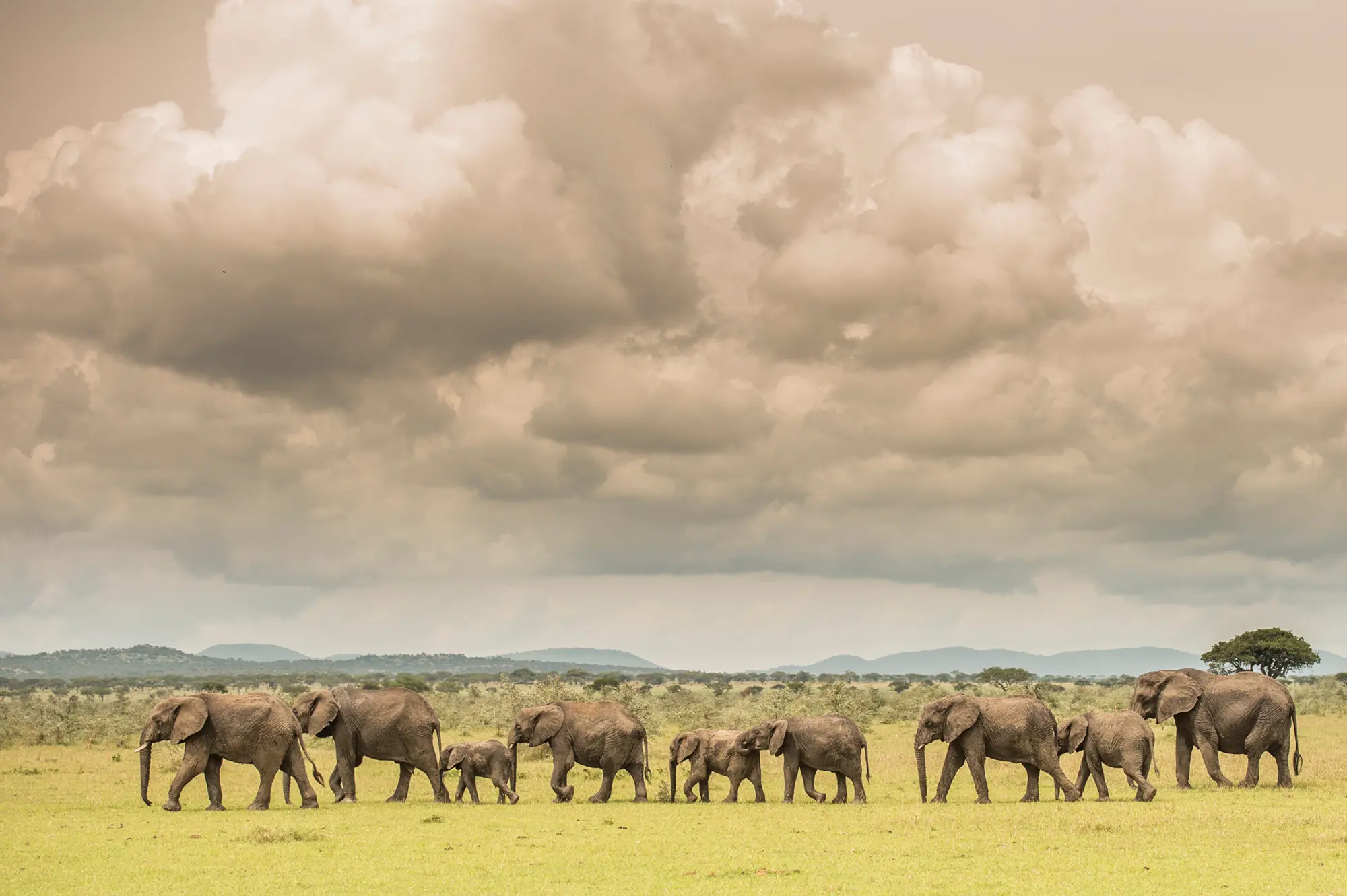
There is a particular kind of quiet that settles over Tarangire in the late afternoon. The light goes long and gold across the grass, the baobabs throw shadows that stretch for what feels like half the plain, and somewhere nearby, without much fuss, a herd of thirty or forty elephants is making its way toward the river. Nobody else is watching. There is no queue of vehicles, no radio chatter about a sighting two kilometres away. It is just the herd, the light, and you.
This is not how most people picture a Tanzania safari. The Serengeti, with its endless horizon and its starring role in every wildlife documentary ever made, tends to dominate the imagination. And rightly so, it is an extraordinary place. But during the months when the Serengeti is at its busiest, when vehicles cluster around a single resting lion and the road dust never quite settles, Tarangire is often doing something quieter and, in its own way, more rewarding.
An Elephant Stronghold, Not a Footnote
Tarangire holds one of the largest elephant populations of any park in Tanzania, and during the dry season, from roughly June through October, that population concentrates along the Tarangire River in numbers that are genuinely difficult to describe until you have seen them. Herds of fifty, sixty, sometimes more, moving and feeding and bathing within view of each other. It is one of the most reliable large-mammal spectacles in East Africa, and it receives a fraction of the attention given to the migration further north.
The landscape itself does a lot of the work. Tarangire's baobabs are some of the oldest and most striking in Tanzania, their swollen trunks rising out of golden grassland in shapes that look almost deliberate, as though someone had sculpted them. Add the elephants moving between them, and the scene has a kind of gravity that doesn't need narration.
By the third day, the rhythm of the place starts to feel less like a wildlife circuit and more like a place you are simply spending time in.
Fewer Vehicles, More Room to Watch
Part of what makes Tarangire feel different is simply arithmetic. It receives a fraction of the visitor numbers of the Serengeti or Ngorongoro, which means sightings rarely turn into a gathering of vehicles. A pride of lions resting under an acacia might have one or two vehicles nearby, not a dozen. That changes the experience in a way that's hard to appreciate until you've been on both sides of it. There is room to wait, to watch, to let a moment unfold without checking whether other vehicles are arriving.
This matters for photography, certainly, but it matters just as much for the simple experience of being there. Wildlife behaves differently when there is less pressure around it. Animals that might otherwise move off when crowded by vehicles tend to stay relaxed, going about their business at their own pace. The result is often a more genuine wildlife encounter, not a more dramatic one, but a more honest one.
How Tarangire Fits Into a Longer Journey
We rarely recommend Tarangire as a standalone destination. Its real strength is as part of a longer northern circuit itinerary, often as a first or last stop, where its different rhythm offers a counterpoint to the Serengeti and Ngorongoro. A night or two here at the start of a journey gives you fewer vehicles, a slower pace, and time to settle into the routine of early starts and golden-hour light before the bigger parks further north.
Equally, as a closing chapter, Tarangire offers a kind of decompression. After the intensity of the Serengeti's open plains and the crater's concentration of wildlife, a couple of quieter days among Tarangire's elephants and baobabs can be exactly the right note to end on.
When to Go
Tarangire's dry season, from June to October, is when the elephant concentrations along the river are at their most dramatic, and it overlaps with the dry season elsewhere in the northern circuit, making it easy to combine. The wetter months bring a different character: the park turns green, migratory birds arrive in large numbers, and the elephants disperse more widely across the landscape. Both seasons have their appeal, and which suits a particular journey depends on what else is on the itinerary and what a traveller is hoping to see.
What We Would Not Recommend
We'd be cautious of itineraries that schedule Tarangire as a single one-night stop squeezed between two longer stays elsewhere, arriving in the late afternoon and departing the next morning. It's enough time to see the park, but rarely enough to experience the rhythm that makes it distinctive. If your schedule only allows one night, that's still worthwhile, but it's worth knowing you're seeing a preview rather than the fuller picture.
We'd also be cautious of treating Tarangire purely as a "warm-up" before the Serengeti. It can play that role well, but if it's framed only as a stepping stone, it's easy to rush through without giving the elephant herds and the baobab landscape the attention they reward.
Curious How Tarangire Fits Your Journey?
We build Tarangire into northern circuit itineraries in a few different ways depending on timing, pace, and what else you want to see. If this sounds like the kind of place you'd like to spend a quiet morning or two, get in touch and we can talk through where it might fit.
Discuss a Quieter Tanzania RouteTarangire isn't a place that announces itself. It doesn't have the name recognition of the Serengeti or the singular geography of Ngorongoro Crater. What it has is space, a different kind of wildlife encounter, and a pace that, once you've experienced it, is difficult to forget.
Related Reading
To see how Tarangire fits into a wider visit, explore the Tarangire National Park destination page, or look at Classic Tanzania Safari and Family Safari for two itineraries where Tarangire plays a meaningful role rather than a passing stop.